Contact Us


 read
For creative, marketing and communications businesses, this week’s Budget brings a mixed verdict.
The key question for agencies isn’t simply whether the Budget leaves businesses with more or less money. It’s whether it changes the economics of winning clients, hiring people, investing in growth and converting new business into profitable revenue.
For smaller and medium-sized agencies, its greatest value may be that it allows decisions to move forward. Frankly, not much happened for businesses in the budget outside of certain sectors, so “let’s wait until after the Budget” has reached its expiry date.
For an agency owner or Managing Director, the impact is across three areas:
The task now is to understand what has changed, identify where clients have reasons to invest, and build momentum before 2027.
This is what we will be doing with and for our clients.
There is no increase in headline National Insurance or VAT rates, while the corporation tax roadmap remains in place. That offers continuity, rather than a reduction in the cost of employing people.
Meanwhile, the National Living Wage rises 3.9% to £13.21 from April 2027. Agencies with lower-paid junior roles will need to account for this, potentially alongside pressure to preserve salary differentials.
Business rates announcements require care. Agencies serving the retail, hospitality and leisure sectors may benefit indirectly if clients gain financial breathing space, but that money will still have competing demands. Equally, increases in gambling taxation could impact agencies heavily involved in that industry.
There are opportunities around scale-up and public sector procurement. The Budget includes support for innovative and growing businesses, improved access to finance through the British Business Bank, and plans to make public procurement easier for innovative firms to access. Agencies serving technology, innovation, regional development or other growth sectors may find opportunities in the clients and projects these measures support. But there is no automatic increase in marketing budgets, nor a guaranteed pipeline of agency contracts.
Yes — provided the investment is tied to a measurable commercial outcome.
Small and medium-sized agencies have less room to absorb higher costs or a delayed client decision. Larger agency groups can spread exposure across more accounts, markets and services.
For an agency that has been overly reliant on referrals, repeat clients or a small number of large accounts, there is a strong business case for examining new-business investment now.
We would ask three questions:
On winning a large media account, a client of ours once famously announced “Great, but sure as anything we’ll lose that client at some point. We need to focus on the next one!”
Good sized clients represent risk. A structured new-business programme can help diversify and dilute that exposure, build a more predictable pipeline and reduce dependence on a handful of clients.
The relevant question isn’t simply “Can we afford business development?”
It’s also “Can we afford to continue without a consistent way of winning new clients?”
Smaller agencies need fewer significant wins to make meaningful progress. Three additional clients generating £100,000 each in annual agency fees would add £300,000+ to growth before churn. That is only the initial 12-month value and not the lifetime value of those clients, potentially over a good number of years, which could be very significant.
Delivery costs and capacity determine how much becomes profit. Nevertheless, the scale of the task matters: a handful of well-chosen relationships can materially improve a smaller agency’s year, but this needs planning for and working towards now if you want to impact 2027.
Different agencies need different new business interventions and should have a deep dive into their sales data to identify the gap.
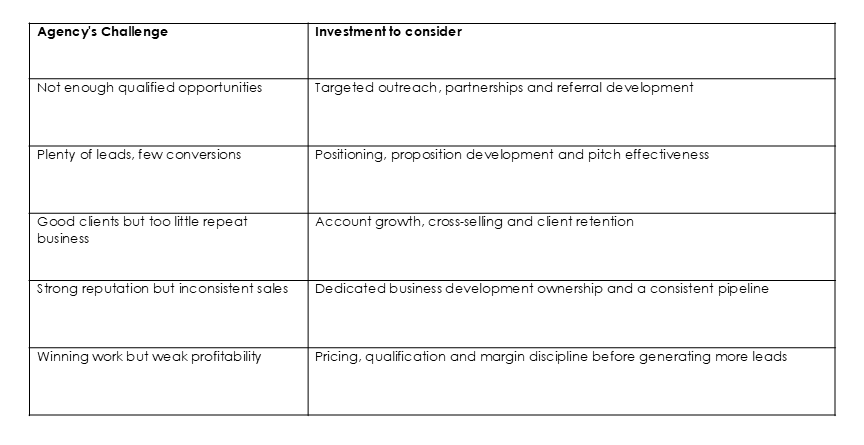
Smaller agencies can compete by making themselves straightforward to buy: a clear specialism, senior access, convincing evidence and a tightly scoped first assignment.
The next step is practical and something we will be doing for all clients: Revisit prospects who postponed decisions. Ask what the Budget changes for their business. Establish which projects now have approval, which remain constrained and where an initial project could unlock further opportunity and progress. Then maintain regular, informed contact with the people making those decisions.
Waiting for clarity was understandable. Waiting for universal confidence could consume another quarter.
The Budget has given agencies a new basis for planning. Those that turn it into relevant conversations now give themselves a better chance of entering 2027 with relationships developing, proposals progressing and new business already taking shape.
If you would like to discuss how Alchemis can help with any of your 2027 new business plans or challenges, please get in touch.
 Email Us
 +44 (0)20 7836 3678